V
Five of Swords
Symbols in the artwork
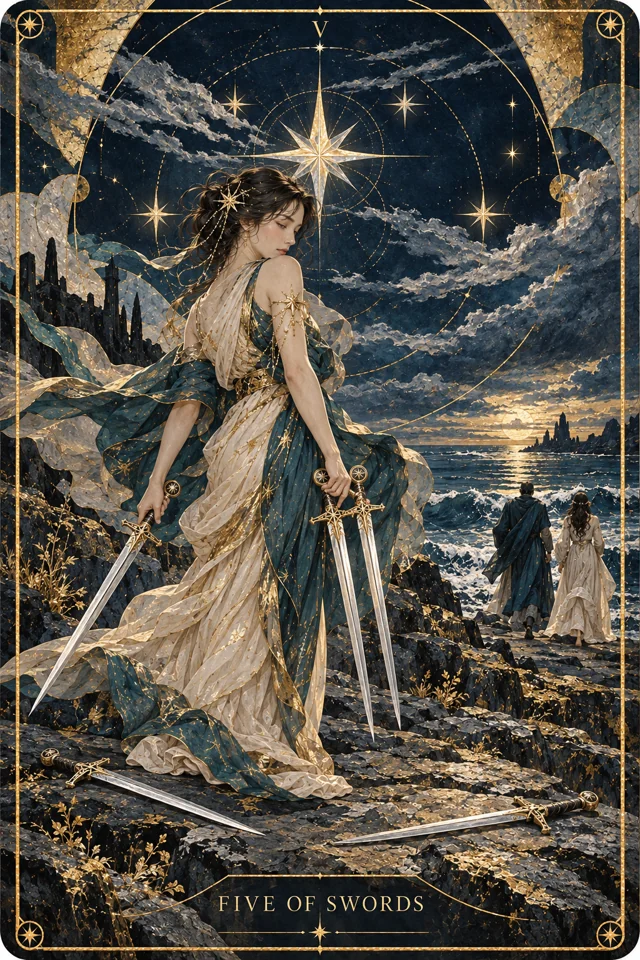
The person in front holds one sword in one hand and two in the other. A total of five swords are visible, including the two lying on the ground. Two people in the background walk away from the water, their backs to the viewer. Clothes are blowing in the wind, and clouds and waves surround them. The image suggests the lingering emotional burden and relational strain after a dispute, rather than predicting who is right or wrong, or foretelling future conflict.
Sources and interpretation
The original deals with damage, dishonor, and loss, and the reversed also includes similar meanings and funerals. Reconciliation and compromise are modern interpretations added, and the damage from conflict is also included.
Written with reference to Rider–Waite–Smith symbolism and modern interpretations.
A. E. Waite's original text · Tina Gong / Labyrinthos modern interpretation
Upright
Conflict and defeat · Victory at a cost · Damaged trust
Even if my words were accepted, reflect on what remains after the dispute.
Core meaning
The Five of Swords symbolizes conflict and defeat—a victory that comes at the cost of relationships and trust. This card asks what you sacrificed to achieve your goal.
The person holding the swords and the two walking away remind us that how we felt during the process is as important as the outcome. It does not mean that every conflict must end positively. You can clearly state what you cannot accept, but you can also reduce the tendency to belittle the other person. Try to distinguish between what needs further discussion and what needs to stop now, and decide what you will confirm next.
What to keep in mind
Be careful not to feel that yielding means losing, or to think it is acceptable to use insulting words to achieve your will. Examine both what must be maintained and the impact of your tone.
One small step today
Write down what you initially wanted from a recent dispute and the lingering burden. Choose one thing to maintain and one word to reduce next time.
A question to consider
Do you want to solve the problem, or do you want to hear that the other person was wrong?
A thought for today
You can choose what you must maintain and when to stop, without having to confront everything until the end.
Reversed
Attempt at reconciliation and compromise · Lingering resentment · Aftermath of conflict
If you want to stop arguing, discuss what needs to change next time.
Core meaning
The Five of Swords reversed can be read as a desire for reconciliation and compromise. Conversely, it can mean that resentment, vengeance, and the damage left after conflict persist, so do not assume the dispute is over.
You might be covering up necessary conversations for fear of further arguing, or you might still be mentally reviewing who 'won.' Just because things are quiet does not mean everyone's thoughts align. Try to distinguish between what can be discussed comfortably now and what situation must be stopped. It is better to confirm the actual changes in behavior and the boundaries you both must maintain, rather than rushing to reconcile.
What to keep in mind
Do not force apologies or reconciliation just because you want the conflict to end. Silence does not equal agreement. Examine the lingering feelings and the actual changes in behavior.
One small step today
Write down the difficulties remaining after the dispute and one action to change next time. Also, discuss specific promises you both must keep.
A question to consider
Has the problem actually changed, or have you stopped speaking because you don't want to argue anymore?
A thought for today
Listen to the remaining feelings, and set small promises to reduce similar disputes.
Tarot offers a way to reflect on yourself through its symbols. Read it as a point of reference, not a certain prediction of the future or another person's feelings.